Friday, 14 February 2020

1924 Challenge Cup - Part 2

Welcome to Part 2 of my look back to our 1924 Challenge Cup run. We left the Wiganers heading into the Cup Quarter Finals where they were to face Hunslet...

Saturday 15th March 1924. Challenge Cup Quarter-Final vs. Hunslet @ Parkside, Hunslet. 13-8 att: 23,500
Wigan warmed up for the Hunslet game against a dogged and tough Warrington team who played with only 12 men! Like Wigan, Hunslet had already made two Final appearances but the difference between the two sides was that Hunslet were triumphant in one of them with a 14-0 victory over Hull FC in 1908. Wigan were yet to play Hunslet in the League home or away so it was difficult to see how the game would go. Hunslet were seventh in the League on a 64% win rate compared to Wigan's 82%. The bookies made Wigan favourites but it would be a tough encounter, especially as 12-man Warrington had made it difficult for Wigan the weekend before.


For Wigan fans, this Cup-tie was seen as the biggest post-War match the club had participated in. The Cup was still coveted by the Wigan public and this was justified with a record 23,500 atendance at Hunslet's Parkside ground with record receipts of £1,738. Such was the popularity of the Cup-tie in Wigan, two special excursion trains were put on to cope with the away support. Going up to kick-off time, thousands of supporters were still trying to enter the venue and an estimated 20,000 supporters were inside at 3pm, half an hour before kick-off. Luckily, everything went well and all managed to fit inside somehow. The Wigan team were largely unchanged from the one that defeated Warrington with only Lou Brown replacing Percy Coldrick in the forwards.


Percy Coldrick missed the game against Hunslet
(wikipedia pic)
Hunslet started the better as they set their stall out from the off, Wigan hardly had a chance to do anything other than to defend. The Parkside forwards were up for this encounter and actually managed to cross the line. They would have taken the lead had it not been for Danny Hurcombe to snatch the ball from Clarkson and clear it in time before it was grounded. With this effort from Hurcombe, the game seemed to sway Wigan's way. eventually, the ball kept finding the hands of the Wigan backs as they settled down to their usual routine plays. The next half hour was all Wigan as a Howley-Ring partnership was a joy to watch with darting runs, clever passing and clean breaks dominating the Hunslet equivalents. The Hunslet forwards were dominant in the srummages, a continuation of the domination they enjoyed in the early stages of the game, but the difference was Jerram and Hurcombe at half back. They had the know-how to send the ball out wide as quickly as possible to the backs, knowing that the Wigan forwards were second best. Wigan took the lead through Van Heerden after afine break by Danny Hurcombe had given Van Heerden an easy score and was to be the highlight of the match. Tommy Howley scored again for Wigan after good play from Johnny Ring which let Wigan go in 8-0 at half time.

Hunslet were still in the game, they were beating Wigan in the forward department but lagging behind in the backs. After the break, a quick breakaway by the Hunslet pack ought to have resulted in a score, but it was the Central Park men who secured the points. A few minutes after the re-start, Howley cleverly intercepted a pass by Young to Cottam. The Wigan centre ran up field, made a short punt and followed up to score near the posts. Sullivan kicked the tricky goal to give Wigan a 13-0 lead. The Hunslet forwards kept at it though, continuously edging up field from scrummages and winning the tackles. Wigan's hero was to be Attie Van Heerden. The South African intercepted several passes near the Wigan goal, on one occasion, one interception saved a certain try for Hunslet. However, Hunslet were rewarded for their continued pressure as eleven minutes into the second half, they got onto the scoresheet at long last. From a scrummage, one of their forwards literally pushed his way across the defending Wigan backs over in the corner but failed at the conversion attempt to make it 13-3. Such was the Wigan three-quarter dominance, Clarkson of Hunslet was moved from the forwards into a back position to try and cancel out whatever the Wigan quartette threw at them. The numerical advantage did not help as the speed and passing of Wigan was too great for the five Hunslet backs to cope with. Hunslet scored a late consolation try after frantic play by both sets of players, chief of whom Sullivan, led to the ball being free and finding a hunslet set of hands to go in for the score. Wigan had won and now were in their seventh Cup semi final, just a game away from the Final.


Saturday 29th March 1924. Challenge Cup Semi-Final vs. Barrow @ The Willows, Salford. 30-5 att: 20,376

Nearly 78,000 people had already seen Wigan play in the three rounds of the Challenge Cup so far in the competition, easily a record if there was such a one being kept. Such was the popularity of the Cup in Wigan, many fans believed this was to be their year at long last. The only thing now that stood in the way of Wigan and a third final appearance was Barrow. The Furness team were sitting below mid-table in the League with a 46% win rate, compared to league laders Wigan who were on 83% thanks to recent fine wins over Leigh (43-9) and Rochdale Hornets (57-5). Two weeks before the semi, Wigan enjoyed seeing another mammoth crowd when Leigh were defeated once more and a week later, Jim Sullivan scored a record 12 conversions for a League match against Rochdale at Central Park. Johnny Ring scored four and Van Heerden scored a hat-trick in the Rochdale game, with Parker and Price scoring twice also. It wasn't looking good for Barrow at all with any hope of a win was dashed in that two-week period.

Hope is a funny word in sport, for example, St Helens hoping to emulate the success of Wigan. Funny. Barrow hoped that they would face Oldham or Huddersfield in the semi, not Wigan. They also hoped to catch Wigan on an off day at Salford. A year earlier, Barrow were in a similar position when they earned a replay against eventual winners Leeds but lost. The men from Cumberland had never reached a Challenge Cup Final and were just as desperate as Wigan to get into one. Barrow started their Cup campaign with a short travel up the Cumbrian coast to Dearham, just North of... Flimby & Fothergill... and east of Maryport. Despite being 18th in the League at the time of the semi final, Barrow had then beaten Hull Kingston Rovers and Warrington in the Cup to progress, both close affairs. The venue of Salford, The Willows, was a common one in those days. most grounds in Lancashire were inappropriate for such an occasion. The other Semi-Final between Oldham and Huddersfield took place at Thrum Hall, Halifax, a venue which was deemed to be 'half-way' between the two towns. One thing for sure, all eyes were on Salford that Saturday when the big day came around.


One thing that may have bugged Wigan was that The Willows was the scene of their first Cup Final in 1991, that day Broughton Rangers were victorious in front of 8,000 spectators. Today however, 20,376 crammed into the Salford ground (receipts of £1,600) in the hope that (for the majority of spectators) Wigan would earn a place in the Final for a third time. The other semi-final attracted roughly 20,000 people but took more in terms of receipts (£1,700) as the entrance fee was slightly different. Same old RFL. Wigan started the game as favourites, being league leaders of course but also due to their previous win in league competition by 28-8 the past September.

Once all were inside, the referee was happy to blow his whistle and commence the match. Wigan won the toss and captain Jack Price decided to play with the wind in Wigan's favour. The opening of the match was quite an equal affair, Barrow had their moments through centre Carr, whilst Van Heerdens now trademark chip-and-run tactic failed to deliver up the other end of the field. The fullbacks gave great early exchanges as Sullivan, of Wigan, and Spender of Barrow equally outdid eachother finding touch with long punts. Wigan took the lead when after a stubborn defensive effort by Barrow, Tommy Howley kicked a neat ball out wide to Johnny Ring who followed up well and swerved around fullback Spencer to score at the corner. Jimmy Sullivan failed at the conversion attempt but it was still early in the match. Although Wigan took the lead after seven minutes' play, they were not producing their best form for they neglected their usual combinational plays from their backs and opted instead to let Jim Sullivan kick Wigan about everywhere. Wigan gave away a penalty a few moments later for obstruction near the Wigan line which got Barrow back into the match with a penalty kick.

Earlier in the game, Barrow suffered the loss of their forward Daniels who had a nasty cut on his head. upon his return, Daniels got the Barrowians moving again and being more than agressive with the Wigan boys. Barrow were now on the front foot and could have taken the lead when Braithwaite passed to centre Carr who advanced toward the Wigan line, but luckily he was tackled in time and without support, surrendered a fine scoring opportunity. Just as things were going well for Barrow, it got a lot worse. Gunning went off injured and almost immediately after this, Johnny Ring scored his second try of the game, evading four tacklers to score at the corner. Sullivan again missed the attempt as Wigan moved up to 6 points. Barrow then came close again via Thornburrow who only had to receive the ball to score on the line but failed to get hold. Less than a minute later, Barrow came within inches of the Wigan line after Wallace made a burst up field before passing to Scott who was ultimately tackled just in time. Wigan were on the back foot again as Scott tried his luck once more but Jim Sullivan managed to snatch the ball and kick it clear at the goal line. Wigan needed a break, and they got it via Danny Hurcombe, literally. Hurcombe found an opening after a scrummage in midfield and ran up field before passing to Parker who then gave to Attie Van Heereden to score in at the corner. Van Heerden had now scored in every round of the Cup but more importantly, for now, was that Sullivan had missed his third difficult kick of the afternoon. Harry Banks, the Wigan forward, dribbled the ball upfield for an age. he looked certain to score when he only had the Barrow fullback Spencer to beat. Spencer heroically dived at Banks' feet and somehow prevented a certain score. In a fantastic bit of play for the spectator, Spencer then got up, collected the ball, passed to centre Carr who then ran halfway upfield before passing to Thornburrow who transfered a low kick towards the Wigan goal line. Luckily for Wigan it found touch just before it got to the corner flag. Just before halftime, and after several Barrow efforts at a try, Sullivan missed his fourth kick of the game after Barrow were penalised when Wiganer Rowley was tripped. Half time came with Wigan leading 9-2, but it should have been a lot more.


Danny Hurcombe was 'average at best' against Barrow
After the interval, Wigan only took five minutes to get on the scoresheet once again. Howley initiated a fine movement when he drew the opposition in before creating an opening for his pass to Hurcombe who easily scored unopposed. Finally, the name 'Sullivan' appeared on the scoresheet after his first success of the game. Wigan were then awarded a penalty after the Wigan stand off Hurcombe was obstructed whilst trying to collect a kick through he made. Again, for the fifth time out of six attempts, Sullivan failed at the attempt at goal. The game then got a bit ugly when in a scrummage, Jerram of Wigan and Barnes of Barrow were sent off for striking. Both players retired to the touchline and were settling down to witness the contest, when the referee stopped play and sent them both to the dressing rooms. Captain Jack Price, now playing in the halfbacks thanks to Syd Jerram's absence,was making a real difference in his new role. With a dribble, Price kicked the ball into the Barrow goal but unfortunately, a Barrow hand touch the ball dead before a Wiganer could dive upon it. Harry Banks drove towards the line moments later but was held up inches short. Playing the ball to himself, Banks dove over to score Wigans fifth try and give Sullivan a chance to kick his second goal, which he did. Barrow were down to eleven men moments later when Daniels, who suffered a head wound early in the first half, retired still suffering from his injury. Despite the number difference, Barrow scored their first try which was failed to be converted. Johnny Ring then thought he had a hat trick of tries but for only it to be ruled out via a forward pass. Not to worry though, Hurcombe, who must have been the Man of the Match by now, put in a kick from a scrummage and successfully pounced upon it to score a minute after Ring's disallowed try. Sullivan kicked his third goal. Barrow with eleven men were now waiting for the hooter. Wigan scored two more tries via Price and Van Heerden, both failed to be converted by Terrible Jim. It dididn't matter... not one jot! Wigan were now in the Cup Final for the third time in their history with their 30-5 win over Barrow.

Oldham had successfully held off Huddersfield in the other semi final to make it an all-Lancastrian affair for the first time since 1911. Weirdly, Wigan were in the 1911 Final but lost to Broughton Rangers 4-0. The press and fans were now asking whether it would be third time lucky for Wigan and rightly so. Oldham had appearaed in three previous Finals but had only been successful once, 25 years earlier. By all accounts, the Semi against Barrow was a dull occasion. Wigan had failed to emulate their League form whilst their backs lacked fluid passing, resourcefulness and accuracy. In fact, only one passing move resulted in a try from the Wigan backs - the last try of the game via Van Heerden. Jack Price took great pleasure in showing how to get the ball from the forwards to the Wigan backs when he filled in for Syd Jerram at halfback. The pairing of Jerram and Hurcombe was average at best and the fluidity of passing was only sparked once Jerram was sent off and Price filled in. All that mattered was that Wigan were into their third Cup Final... against Oldham.

TBC...


Flimby & Fothergill - Valentines Day 1925


Flimby & Fothergill eh? Who's that or what is it? It sounds like an accountancy firm or a solicitors. In fact to many Wiganers, Flimby & Fothergill lies in our hearts, minds... and record books. Many will know of Flimby & Fothergill by hear say, or glanced upon their name scouring record sheets. They have the honour of being the victims to Wigan's highest ever score: 116-0. Other records were broken that day and still stand the test of time. Jim Sullivan, Wigan's epic captain and goal kicker set a new club record of 22 goals in a match and also a points scoring record for a single game with 44. Johnny Ring crossed for 7 tries as Wigan put the sword to the Cumberland Champions in the Challenge Cup.

It was a one-sided affair in the end. The Cumberland League was amateur compared to playing the likes of Hull FC, Wigan and Hunslet. Wigan's team that day were: Jim Sullivan, Johnny Ring, Tommy Howley, Danny Hurcombe, Attie Van Heerden: George Owens, David Booysen, Tommy Beetham, Carl Burger, William Banks, George Van Rooyen, Frederick Roffey and Jack Price. The most famous name coming out of this tie was of course Jim Sullivan who kicked an amazing 22 goals from 24 tries. At the time, Wigan's last match in the Challenge Cup was the Final played at Rochdale where Wigan defeated Oldham 21-4. I guess Flimby & Fothergill didn't really have a chance once their name was pulled out of the hat and drawn against Wigan.


Wigan at the time boasted some very talented players. Johnny Ring scored for fun and the picture (left) show's Wigans 1924 tourists who travelled to New Zealand and Australia and include (from top left to right) Danny Hurcombe, Johnny Ring, Tommy Howley, Jack Price and Jim Sullivan.

116-0! Back then you have to remember that 3 points were awarded for a try not 4. If we give it a modern day scoreline it would be 140-0. As the match report suggests, it was a farcical game. Wigan kept getting the ball and running upto the other end and scoring. These days you'd think that such games are terrible or pointless. On the other hand history can be made. Sullivan's accuracy was phenominal... 22 goals from 24 attempts - it doesn't matter about the opposition when you kick for goal, he was lethal that day. His personal haul of 44 points has never been bettered. Pat Richards, in 2010, came close with 38 points - scoring 5 tries and landing 9 goals in a league demolition match against Catalans Dragons. Shaun Edwards and Martin Offiah accumulated 40 points both in 1992, scoring 10 tries each against Swinton and Leeds respectively. Johnny Ring broke a try scoring record for tries in a match with 7... he later equalled it 2 months later in a league match against Salford so it is safe to say he had confidence on his side at that period.

We shall go back to Valentines Day, 1925. This is the match report from that game. You can download a pdf file of this and save it for yourself if you like - just follow the link by clicking on the image.

Wigan's Easy Entry to Second Round

The Cumberland Champions Badly Beaten

WIGAN v FLIMBY AND FOTHERGILL116 POINTS TO NOTHING

RAPID SCORING

Wigan's entry into the second round of the League Cup proved very easy, in fact, too easy. Flimby and Fothergill came to Central Park with a very fine reputation. They are the champions of the Cumberland League and winners of several cups, and no doubt this was the cause of a very excellent crowd who thoroughly enjoyed the game, although Wigan did put up such a huge score. To put it mildly, the visitors had not a ghost of a chance. They knew they were up against a stiff proposition. They also knew what brilliant players they had to face. They came on the field in a very sprightly manner, but after all the chasing of the Wigan players it was plainly seen that they were absolutely tired out. The home team scored so rapidly that it was one continual procession of the visitors to behind the posts while Sullivan kicked the goals. One player was so tired of this that he got behind the touch judge and Van Rooyen, a move which caused a roar of laughter. Then the referee noticed him, and after Sullivan had kicked the goal this official went to him and shook him by the hand. This caused another roar of laughter.Regarding the game there was only one team in it, as and time went on play became more or less a comedy. Wigan̢۪s combination simply baffled the visitors: they threw the ball about in such a manner that at times the Cumberland team were lost.

They had a fair number of supporters and as points were piled up they were always cheerful. The visitors started in fine style, and that was all. It might have been an exhibition game as far as Wigan were concerned. The home team simply showed the visitors how football should be played, and we are sure this will be a topic of conversation by the team for a long time. Some brilliant movements were executed by the home backs, in fact, many times practically all the team handled the ball previous to a score. There is one consolation for the visitors, and it is a good one. There was an excellent attendance, and their share of the gate will recompense them for the heavy defeat. Some records were put up. This was the highest score that Wigan have ever made, although not quite a record for a Rugby match. Ring registered 7 tries, Van Heerden 4, Booysen, Price and Hurcombe 3 each. Van Rooyen 2, and Howley and Beetham 1 each, while Sullivan put up a record for one match by kicking 22 goals out of the 24 tries.
The teams were as follows:-Wigan - Sullivan: Ring, Howley, Hurcombe, Van Heerden: Owens, Booysen, Beetham, Burger, W. Banks, Van Rooyen, Roffey and Price.Flimby - Risson: Peel, H. Atkinson, D. Ackersley, Robley: J. Ackersley, B. Atkinson, Richardson, Lewis, Holliday, Davidson, Irving and Little.Referee: R.H. Cooper, Hull.
 
THE SCORING SOON BEGINSThe visitors won the toss and Price set the ball going. The visitors soon made an attack on the home line, when Sullivan picked up and broke through the opposition and passed out to Howley. The centre ran some distance before passing to Ring. The wingman put on top speed and scored under the posts, for Sullivan to have an easy kick at goal. Five points were thus scored in the first two minutes. The game had no sooner re-started than Owens got away from the scrummage, the backs taking part in a passing movement which ended in Ring being well collared almost on the line. When the ball came loose it travelled right across to Van Heerden, and the South African made tracks for the line and scored, Sullivan goaling. Wigan were now showing some of their most brilliant form, their passing movements being very fine. The forwards were also getting possession of the ball whenever they liked. This supporters would like them to do against stronger combinations. From a scrummage Booysen got away and passed to Ring, who made a bold bid for the line, and was only just pushed into touch at the corner.
 MORE AND MORE POINTS 
Wigan now began to settle down, and points were added very rapidly. The home backs indulged in a splendid passing movement and Van Heerden was able to score again. Several attempts were made to stop the winger's carry, all of which failed. Sullivan did not kick the goal. On re-starting Wigan again went to the attack and Beetham did some fine work. The forward picked up smartly, and after beating several opponents gave Van Heerden a wide pass: the winger took the pass in fine style and scored, Sullivan adding the goal points. The play continued to be in Wigan's favour, and from a scrummage, Hurcombe broke through in good style, and when faced by the fullback gave to Howley, who added more points by crossing under the posts, Sullivan converting. A little later, Van Rooyen made a fine run and looked like scoring when he was well tackled. The player who stopped him was on the small side and this caused a roar of laughter. Very soon after Van Heerden was able to register his fourth try, again did Sullivan kick the goal. Try as they would, Flimby and Fothergill could not get going at all, being beaten for possession and slow in their movements. 
Owens got penalised for offside, and the visitors were now near the Wigan 25 line. The Central Park men gradually worked their way down the field, and Ring scored again, for Sullivan to goal. Play had not been re-started more than a minute when Van Rooyen scored, Sullivan having an easy shot at goal. Scoring by Wigan continued very rapidly. From a scrummage Booysen beat all opposition and scored. Sullivan kicking the goal. The visitors made a raid on the home line, but were very soon repulsed. Forward passes by Wigan backs spoiled several chances, and these placed the visitors on the attack, and a mistake by Ring almost proved successful to the Flimby team. Every effort that was made by the visitors received some applause, and a score to them would have added more interest to the game. A fine breakaway by Van Rooyen ended in another score. The burley forward placed Hurcombe in a good position, and scored under the posts, Sullivan again goaling. 
NOT DOWNHEARTED 
Although the visitors were now a well beaten team, they were not downhearted. Ring again crossed, and Sullivan was again successful with the goal kick. Just before half-time the Cumberland champions made a bold dash for the Wigan line, but all their efforts proved futile, and at half-time the scores were:--
Wigan 10 11 53 pointsFlimby and Fothergill Nil. 
POINTS GALORE IN THE SECOND HALF. 
The second half had not been in progress long before Hurcombe broke away and gave to Van Rooyen who scored, Sullivan goaling. Another score was soon added, as from a scrummage Owen got away and gave to the Wigan full back, who passed to Van Heerden. The winger returned the pass to Sullivan who sent to Price, who scored, Sullivan goaling. It was only a rare occasion the visitors made any show at all, being beaten for speed and stamina all the way through. Wigan had been scoring when they liked, and the game was practically a farce. Further tries were added by Ring 4, Booysen 2, Hurcombe 2, Price 2 and Beetham, Sullivan adding 10 more goals.

Final result:WIGAN 22 24 116 points 
FLIMBY AND FOTHERGILL.. Nil.
 The gate receipts were £525

Records are always there to be broken, but not yet it seems. Wigan have only gone over 100 points once since 1925 when they beat Whitehaven 106-8 in 2008. In 2012, North Wales Crusaders threatened to fling Flimby & Fothergill from the record books during a Challenge Cup game at the DW Stadium. Wigan looked set to beat 116-0 but some silly errors cost certain tries, and with Crusaders rallying before their sole try it wasn't to be. Wigan winger Josh Charnley ended up missing a decisive conversion that would have put up three figures but with a total of 18 tries, it wasn't to be.
Perhaps the spirit of Flimby & Fothergill will always live on.
So where is Flimby and Fothergill? Cumbria is the short answer. Flimby is a coastal village south of Maryport


Thursday, 13 February 2020

1924 Challenge Cup - Part 1


When we look back on great achievements one accomplishes, we always have to have a starting point. For example, Wigan's famous eight Challenge Cup successes were started on a muddy pitch with a 2-0 win over Bradford Northern on 30th January 1988, and Wigan's survival revival from relegation in 2006 could arguably be dated back to 20th April 2006 when Brian Noble took over as head coach. The Greatest story that runs right through the Wigan club is that of the Challenge Cup. Since the competition began back in March 1897, Wigan had failed to lift the already famous trophy up until 1924. In that 27 year period, Wigan had won everything under the sun and were the biggest name on a rugby pitch but somehow the Challenge Cup had eluded the Central Park Club for over a quarter of a century. The 1923/24 season saw to that and with Wigan's first triumph saw a love affair with a piece of silverware that is just as strong today as it was back in 1924.

Before the 1923/24 season however, Wigan had only reached the Final on two occasions, losing both to Broughton Rangers in 1911 and Huddersfield in 1920. Wigan hadn't been at the races at all in the competition and with their 2 Final losses, they had also lost in 4 other Semi Finals. Hopefully, that was to change in the 1923/24 season. Wigan now boasted a terrifying back line that included free-scoring wingers Johnny Ring and Attie van Heerden, along with goal-kicking prince Jim Sullivan at fullback. In the League campaign, Wigan got off to a flyer by winning their first four matches against Wigan Highfield, Halifax, Salford and Hull FC before losing away to Leigh 13-9 (Johnny Ring scoring a hat-trick). A win against Barrow and another 13-9 loss, this time to Batley, gave Wigan a bit of time to think where they were at. By the end of October, Wigan started another run of form with four more comfortable wins on the trot before Oldham stopped the Central Park march on the 1st December with a 10-2 win at Watersheddings. It was only a blip however, as Wigan went through December unbeaten by thrashing Salford 49-0, defeating Huddersfield (18-10) and Swinton (10-4), thrashing local rivals St Helens 44-2 (four players scored 2 tries each) on Boxing Day before ending the year by narrowly pushing aside Broughton Rangers 5-0. 1923 ended with Wigan at the top of the League competition having played 17, winning 14 and losing 3 giving Wigan a leading total of 82.35% win rate. Batley were sat in second place on 73% whilst Hunslet occupied third on 69%. As you can see, things were looking bright for Wigan who were a full 10% of wins clear of Batley. The form continued throughout January though Wigan lost twice to Widnes (2-0) and Broughton Rangers (8-2). Although Wigan had now lost 5 games, their greatest loss was by 8 points or fewer which says a lot about the Wigan defence at the time. Even better, Wigan had 5 Great Britain Tourists called up for their Tour which included Jim Sullivan, Tommy Howley, Jack Price, Johnny Ring and Danny Hurcombe. You couldn't have asked for five better British players in the same team at the time, Wigan were lucky!

As February came around, people were starting to get excited again for the Challenge Cup. Wigan's involvement in the Lancashire did not last long, losing in the second round to Oldham at the end of October, so the Wigan public were feeling hungry for a bit of Cup rugby. They were soon to get it! The back story so far in the League is that Wigan were doing fine, clear in the table with a tight defence. The league form people hoped, would elevate Wigan to their first Final triumph but first they had to negotiate three rounds before any thought of a Final appearance. Wigan were due to play Leigh in the first round on Saturday 16th February and Wigan surely got a perfect warmup courtesy of Hull Kingston Rovers. A week before the first round tie, Hull K.R. travelled to Central Park in harsh sleety conditions. Wigan won 36-5 yet Attie van Heerden managed to cross the line five times in front of nearly 9,000 spectators. The mean Wigan defence managed to keep Hull KR out for most of the match but with the win, Wigan were first in the League, having played 26, losing 5 with a win rate of 80.76%. A local derby was next, in the Challenge Cup! An interesting fact thus far was that Wigan had only lost on one occasion at Central Park in the Challenge Cup, that was to Huddersfield, so the omens were good.

Saturday 16th February 1924. Challenge Cup Round 1 vs. Leigh @ Central Park, Wigan. 7-5 att: 32,226

Local derbies are always fun affairs. Households are divided by loyalty and workplaces are like battle grounds. Wigan started their 1924 Cup campaign at home to bitter rivals Leigh, a team that had previously defeated Wigan in the league 13-9 at Hilton Park. Such was the attraction of this Cup tie, the Central Park secretaries had decided not to take any monies at the ground on match day but instead, told supporters to pre-purchase tickets beforehand or entry would be refused. The idea of this was to keep the crowd levels DOWN so that there wasn't to be thousands of fans locked out on gameday. Due to a big crowd being expected, the Central Park pitch was convered a couple of days before gameday just in case the weather got to it. In all, 32,226 spectators were in attendance which was comfortably the biggest attendance the game had seen in many a year with gate recepits of £1,786 breaking many records of the time. In comparison, the next best attended game of Challenge Cup First Round day was that of Oldham vs. Rochdale where 15,790 had taken the trouble to witness Oldham progress. You can imaging the scenes beforehand, train cars brimming with Leythers en route to Wigan Wallgate with Hindley and Ince being swarmed with an army of people marching towards Central Park from the Eastern frontiers of the Borough. A large crowd expected a classic match, and they got it

The Wigan Observer reported on the day of Hull Kingston Rover' maulings, that Leigh had gone into special training, similar to when they won the Cup a few years earlier against Leeds. New foods, 'less' alcohol, longer walks etc... were all in preparation for the Challenge Cup. Leigh were up for this one.

It was a thrilling game by all accounts. The conditions were harsh but the ground was playable thanks to it previously being covered. The cartoon (left) gives an idea as to how the game went. Leigh took the lead via Wally Mooney, the Pocket Hercules with a try that was converted by Boardman to give Leigh a 5-0 start. The Leythers were on the front foot for most of the first half, always attacking thewigan line but the defence held firm. Wigan's league form had shown that whatever was thrown at Wigan, the defence would hold firm. And so it did. Johnny Ring managed to scramble over late in the first half to peg the game back to 5-3 but Wigan captain Jim Sullivan missed the conversion attempt.

Shortly after the restart, Wigan were gifted with a penalty after Leigh had failed to play the ball correctly on their own goal line. Jim Sullivan took the two points and to equal the score up. It could have gone worse for Wigan when Leigh back Mooney broke through and kicked the ball over Sullivan's head. The ball was picked up and passed to E. Thomas but luckily for Wigan he knocked on with a certain score on the cards.

With twelve minutes left on the timekeepers watch, Wigan took the lead through a penalty kick by Sullivan. Leigh had gifted Wigan the 2 points when Leigh were penalised for obstruction in their own half. Sullivan landed the goal amongst "scenes of great enthusiasm" by the home support. Through the second half, the Leigh defence held firm, as did Wigans. Leigh could have snatched it towards the end when Wigan back Owens made a mistake which gave Leigh the opportunity to score. Thankfully, Wigan had Jim Sullivan in the team and with a fine tackle saved a score at the end. Wigan were now through to the second round draw, which would be made at Headingley, Leeds the following Monday. Wigan were drawn at home to play Broughton Rangers two weeks later in Round Two.

Saturday 1st March 1924. Challenge Cup Round 2 vs. Broughton Rangers @ Central Park, Wigan. 49-0 att: 22,000

After the well received Cup win against neighbours Leigh, Wigan were now drawn to play Broughton Rangers at central Park in Round 2. The clubs had met twice in the league, both games being an extremely close affair. Just before 1923 came to a close, Wigan edged out Broughton 5-0 thanks to Johnny Ring and Jim Sullivan. The Rangers got their own back at The Cliff, defeating Wigan 8-2 in mid-January to make meetings between the two sides 1-1 for the season. Broughton had already won the Cup twice, in 1902 and 1911 where they defeated Wigan 4-0 in the Final at Salford. Surely it was now time for Wigan to get their own back but who knew which was the score would go after the two league meetings had been close encounters. In the league game that was sandwiched between the early rounds of the Cup, Wigan comfortably defeated Huddersfield 27-8 to extend their lead at the top of the Championship over second placed Leigh. Wigan were now winning at 81.48% whilst the Leythers in second were at 69%. Broughton went into this Cup game sitting in ninth place winning at 58%.

Broughton had rugby legend and Great British winger Billy Bentham in their ranks that day but could he do one over Wigan? With the Wigan public still on a high from their hard fought victory over Leigh, it was only fair that 22,000 attended this game with gate receipts of £1,120. The next best attended game for Round Two was that of Leeds v Wakefield Trinity which had 20,000 at Headingley taking in £860. Cup fever had gripped the Wigan public's imagination yet again and for most of those 22,000 in attendance, not many left Central Park disappointed (save for the 1,000 or so Broughton supporters). Many critics were expecting a close game and any other day, Wakefield Trinity's win over holders Leeds would have been the shock result had it not been for the fine form of Wigan.

Wigan started the game on the front foot, eager to gain the upper ground and control the game through their forwards. Broughton had a reputation for having some of spediest backs in the game but Wigan's Howley, Ring and van Heerden ran riot against Bentham's lot whilst Jerram and Hurcombe in the halves controlled and dominated the game from the scrum. Jim Sullivan was again faultless at fullback in defence whenever he was called upon whilst his attacking movements which included several turns of speed and accurate passing mesmerised the Broughton defence repeatedly. Up front in the forwards, where the game first and foremost had to be won, the Wigan pack of Price, van Rooyen and Roffey dominated their opponents.

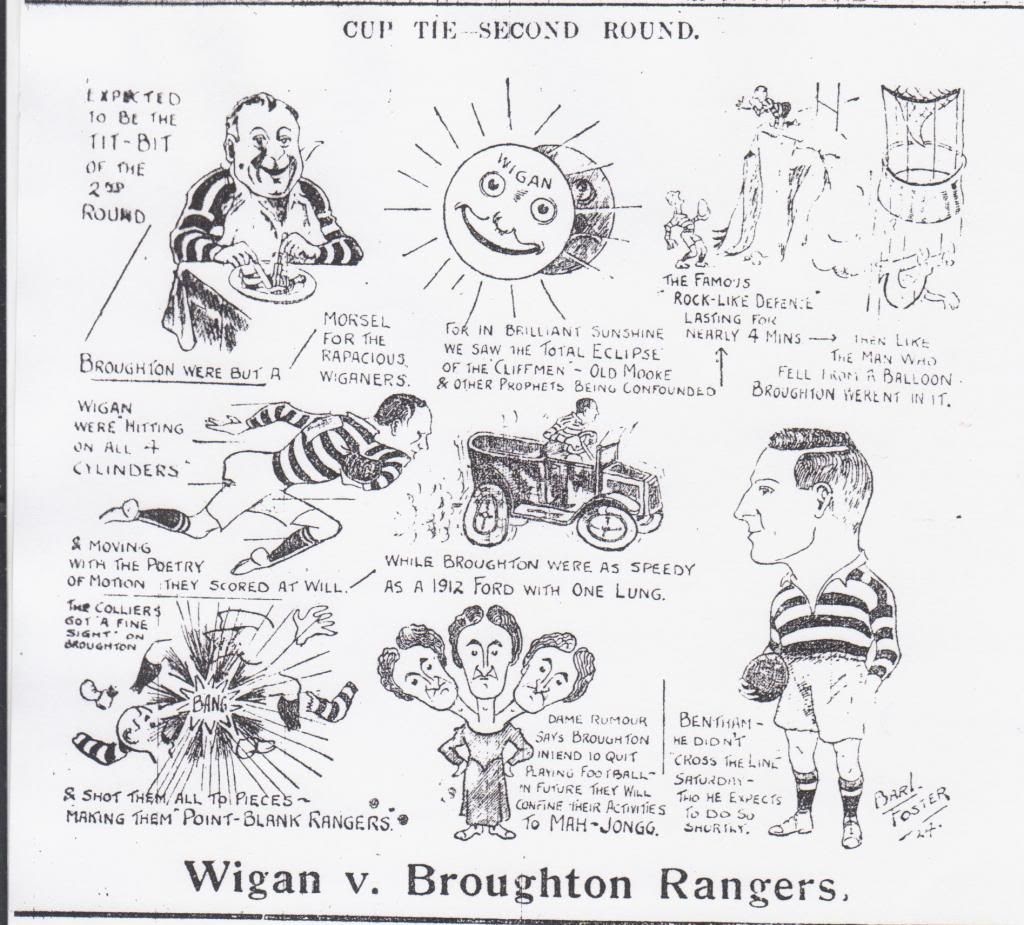
Today, Jack Price captained Wigan but lost the toss in the gleaming sunshine at Central Park. Wigan started the better and after a kicking exchange that, would have bored many at Twickenham, between the fullbacks, Sullivan eventually found touch near the Broughton ten yard line. From the scrum, Johnny Ring dashed to within a yard of the line before Jerram picked up and darted over after just four minutes of play. Although the angle for Sullivan to convert wasn't hard, Old Jim misjudged the wind and missed. Wigan continued to press against the Rangers line when Hurcombe and Howley nearly forced their way over before Van Heerden was forced into touch after a terrific pass by Parker. Wigan furthered their lead shortly after when, despite Broughton making way up field for once, Sullivan kicked a penalty from 3 yards inside his own half after Broughton were penalised for being offside. When Broughton thought they were just about to get back into the game after being under pressure since the start, Johnny Ring intercepted a pass to run in unopposed under the posts. After an exchange of penalties Wigan went further ahead by Howley. Good play from Jerram and Hurcombe ensured that a well placed pass sent the Wigan centre under the posts and another 2 point gift for Jim Sullivan. The game was over by now with half time approaching but Billy Bentham refused to give in. After a break, he scooted down field with only Sullivan to beat but decided to kick and have a foot chase to the line. Sullivan was too good and fielded perfectly to stop the Great British Tourist from letting the Rangers get a foothold in the match. Immediately afterward, Van Heerden was loudly cheered for wonderful play. The South African received a pass from his own 25 yard line near the touchline and sprinted downfield. He was chalenged by the Broughton fullback Rowlands but cleverly, Attie kicked over Rowlands head, collected and scored under the sticks. Wigan could have scored twice more before halftime when Ring was bundled into touch and Parker knocked on a yard from the try line after a low pass by Howley. The whistle sounded with Wigan going into the Pavilion 20-0 at half time.

Wigan immediately carried on as they had finished in the first half. Sullivan floated a pass out to Van Heerden who again ran up most of the field. This time the fullback Rowlands got his man and Van Heerden was tackled. Luckily for Wigan, Jerram was close by and a quick pick up saw him score. Had Jerram not have been near the scene, the referee would have surely given Wigan a penalty try as Van Heerden was obstructed earlier in play. Four minutes into half time, Roffey scored near the posts with Sullivan adding the conversion. Wigan now were going to score at will and that they did. Sullivan kicked a penalty from the halfway line after Broughton gave away a penalty whilst Sullivan and Van Heerden linked up well. Ring scored twice more with Roffey gaining another to end the game 49-0 to Wigan. This was one of Broughton's heaviest defeats and one they would rather forget at the time. Wigan were electric that day, the backs' of Ring, Howley, Parker and Van Heerden were unplayable with their passing moves being top quality. Many people said Wigan had never played a game of rugby league any better in thirty years. Wigan's record of losing only once in the Cup at Central Park would be carried over to 1925 (Flimby & Fothergill anyone?) as the Quarter Final draw meant that Wigan were to travel to Hunslet in a draw made at the Griffin Hotel, Leeds on Monday 3rd March.

Look for Part 2...


Monday, 10 February 2020

Brilliant Young Full-Back Goes North


Welshman James Sullivan came to Wigan as a 17 year old from Cardiff Rugby Union Club in the summer of 1921. 774 games later in the Cherry and White he had broken almost every record the game had to offer, records which still stand to this day. James "Jim" Sullivan, Wigan's greatest ever player.
You may have heard about Jim Sullivan during pub talk or seen his name appear on bits of paper from time to time. Overall his achievements are second to none. In his 25-year career with Wigan, he made 774 appearances scoring 83 tries, 2317 goals and 4,883 points. To this day, his goal scoring, points and appearance records haven't been remotely challenged. For good measure he also holds the record for goals and points in a game - which came against Flimby & Fothergill on Valentines Day 1925. He kicked 22 goals for a record 44 points on that infamous day. And that was just his playing record. Jim also had the honour of being Wigan's first ever coach when appointed to the role in 1932. He stayed on for 20 years where he became Wigan's most successful coach (alongside John Monie) winning 5 Championship titles and two Challenge Cups. He truly is a legend.
Sullivan was a vital cog in an ever emerging Wigan machine. This newspaper cutting from 1923 humorously sums it up: "For once in a way the Wigan full back Sullivan, failed to kick a solitary goal. Result, Wigan lost." His goal kicking record is extraordinary and has only been beaten by Neil Fox. Obviously, being a young Welshman, Sullivan grew up playing Rugby Union and turned out for his local side Cardiff RU at the age of sixteen. He very quickly became their first choice fullback and his goal kicking and talent became swiftly known in Union circles. At the age of seventeen, the teen prodigy got a call-up to the Barbarians squad. Cue the Northern Union circling like a vulture over a dying Gazelle (or something similar).

The 1920s saw the fortunes of Wales starting to subside. Formerly a world leader in coal production and other raw materials - along with heavy industry - the Valleys started to see demand fall sharply. Cheaper coal and labour costs were sought elsewhere around the globe so the demand for Welsh coal plummeted. Depression started to hit South (and North) Wales as the labour intensive industries of mining waned. Interesting stuff, but basically it became increasingly hard for Rugby Union players to play rugby when jobs needed to be held on to. A benefactor of this was the cash-rich Northern Union who would happily pick the cream of young Welshmen with the simple lure of pay per play type income alongside a very good chance of landing a job in a Mill or local industry (the North of England was still booming but economics is for elsewhere). James Sullivan had admirers from Northern towns ever since his goalkicking exploits for Cardiff were first known. Wigan eventually won his signature for a record-equaling fee of £750 at the tender age of 17. Sullivan and his family knew that he could happily play professional rugby - a game he loved - whilst he had the security behind him, a better life than what he'd have had in the bleakness of South Wales. Good timing for Wigan it seems. The 1920s saw a record number of Welshmen turn professional and 'went north' - 37 of them in fact. By contrast, 7 people turned pro in the 1990s (namely Scott Quinell).
Wigan at the time of Sullivan's signing were at a crossroads. Their first dynasty after the turn of the century came and went. Championships and Lancashire trophies seemed to dry up. The Challenge Cup was still elusive after several near misses and two Final appearances, Wigan got nowhere. The old guard of James Leytham, Joe Miller, Lance Todd and Bert Jenkins were gone. It seemed that after the First World War there was an opportunity to start afresh. The 'biggest name in the game' had a second chance to kick on.

From an early age and part of his career, Sullivan was gaining recognition for is talents. In a match away at Gloucester, whilst playing for Cardiff, Sullivan received a rare accolade of being applauded by the home supporters for his efforts: "The infant of the team well merited the tributes paid to him. He gave a flawless and polished exhibition of custodianship".
The game in Wales however was also at a crossroads. A local column in the Welsh Press had this to say about the migration of Welshmen: "There can be no ignoring of the fact that the Rugby League with its fair and open treatment of players is gaining in favour. Players are realising that man lives by not "caps" alone and they are ready to engage their services to the clubs who pay them best... The Rugby League clubs are prepared to buy all the class players there are, and the Rugby union are powerless."
Remind you of anything modern day? Swings and roundabouts. Notable players to go north at this period were Sullivan, Johnny Ring and William Absalom who all had Welsh Union caps. Most can remember the time in recent memory when the newly professional Union game were taking their pick of Rugby League talent. It is still happening to this day. Jason Robinson, Lesley Vainakolo, Andrew Farrell and Joel Tomkins are just a few to have crossed over to try their hand for mega-bucks. It was the same in the 1920s. Fans and local media are always fearful that their young talents will one day leave for fortunes in pastures new. Cardiff Rugby Union however really didn't have a choice but to let Sullivan go, along with others during that period
"Jim Sullivan, the young full-back who last year had such a wonderful rise to fame whilst playing for Cardiff, has signed on for Wigan, the Northern Union club's agents holding out one of the most tempting financial baits ever offered a player.Sullivan was only seventeen when he commenced to play for the [unknown word], and will not be eighteen until next December. Of fine physique, he was one of the most consistent players in Welsh Rugby, and jumped right from a junior club to first-class football. He was regarded as a certainty for his Welsh cap in the coming season.
The fee paid by Wigan is a record one for a full-back. 
Cardiff's loss is a particularly heavy one. Since the war very few young players who promised to atain the standard set up a decade ago have been found, and the discovery of Sullivan in the first half of last season was a great piece of luck. Sullivan then was barely seventeen years of age, and he jumped from St Alban's Old Boys XV, into the Cardiff premier team, making a highly successful debut, and retaining his place to the end of the season. Indeed, so phenomenally rapid was his progress that many good judges consider him to be destined to make one of the greatest full-backs ever produced by the Principality. His splendid physique - he is 5ft 11in in height and weighs 11st. 9lbs - makes it difficult to believe that he is under eighteen years of age. Had he retained his amateur status he would undoubtedly have won international honours. Indeed, he came within an age of being "capped" last February. It will be re-called that on the eve of the French match at Cardiff both Joe Rees (Swansea) and B.O. Maile (Cross Keys) were reported to be injured, and Sullivan was instructed to hold himself in readiness. Maile, however, was sent for, and was passed fit by Dr W. G. Williams.
A FINE PERFORMANCEOne of his finest performances last season was in the trial match at Pontypool, when he astonished the spectators by kicking no fewer than six goals from the halfway line. In every match he won the admiration of the crowd for his fearlessness in going down to the rushes. He kicks an extraordinary length, and his tackling and fielding are faultless. Experience will give him that sense of direction and judgment which at present are not quite as they should be. He is inclined to be on the slow side, but that too can be remedied. His invincible coolness is one of his greatest assets. Undoubtedly, Sullivan was one of Cardiff's greatest "finds" for many years, and it now remains to be seen whether he can adapt himself to the somewhat different conditions which apply to full-back play under Northern Union rules. In this connection it might be mentioned that Wigan has "caught him" young enough to learn." 
So he was nearly capped for Wales very early in his career. What a lucky escape that was. B.O. Maile? who was that I wonder? It seemed that after Sullivan had left Cardiff, there was a successor in place. A Dr. Tom Wallace was touted as being Sullivans replacement, being a current Irish international, a sure kick and good tackler. There were high hopes for him. But in 1924, B.O. Maile had by then left Cross Keys and joined Cardiff... and didnt do much else. If only Mr Maile was injured it could have been a whole new story - who knows what could have happened if a Welsh cap fell onto the head of a rugby-mad seventeen year old Sullivan. From this media piece alone you can sense that the loss was a huge blow for Cardiff. Six goals form the halfway line in a trial match? The superlatives are many.
Did it "remain to be seen" if Sullivan could adapt himself to the Northern Union? Quite easily really. On his debut for Wigan in August 1921, in a game versus Widnes, he scored 5 goals - a decent start. The Hull Daily Mail, commented on the opening games of the 1921/22 season. On what the reporter saw at Central Park versus Widnes:
The man who pleased me the most in the back division was Jim Sullivan, the young Cardiff full-back. Not 18 years old until December next, he will, barring accidents, prove worth every penny expended on securing him, especially to a club who, since the days of Sharrock, have not been to well served in the last line. When this lad becomes more accustomed to the rules there will not be many better full-backs playing. His kicking is beautifully clean; he is not afraid of going down to stop rushes, has a safe pair of hands, a fair turn of speed, and a splendid sense of position.
A SPLENDID DEBUT 
His was a brilliant debut. Three og his five goals were grand "places" and with te only kick at goal which failed to score the effort from the touch line was worth of Ben Gronow.
How right was he? By mid-November 1923 Jim has played in his hundreth consecutive match for Wigan along with a World Record kicking season 1922/23. He wasn't eve 20 years old yet. He was never injured.
The rest, they say... is History. And he played in Cherry and White.

Sunday, 9 February 2020

Sullivan's Golden Boot - World Record

Photo fro RugbyRelics.com
For the benefit of those who somehow do not know already, James Sullivan is Wigan Rugby League's most successful points scorer, amongst other things. During his time at Wigan, Sullivan kicked a record 2,317 goals in 774 appearances which spanned many successful years at Central Park. Jim is regarded as one of, if not the best goal kicker of all time in the game of rugby league by many.
Before he joined the Central Park outfit, Sullivan already had a reputation for being good with the boot - even at seventeen years of age. Wigan however didn't really have an out and out goal kicker in their team. For example in the famous team on the Edwardian period which included Jenkins, Todd, Miller and Leytham, it seemed that goal kicking duties were shared. James Leytham often got the nod and - just picking a randon year 1908-09 season, Leytham kicked 50 goals, with Johnny Thomas kicking 39 and Jim Sharrock 17. This sharing continued in the following seasons until James Leytham's untimely death in 1912; Thomas kicking 68 goals that season with Billy Francis on 21 and so on... The Great War saw the demise of the remnants of the first Wigan team. The game was changing yet in 1919-20 Wigan had 9 goal kickers that season - all stats but you can see that there was no continuity or quality since the early 1900s to the standard of a Jimmy Leytham.

That all changed in 1921. Syd Jerram, George Hesketh and Tommy Howley had the honours in 1920-21 but unsurprisingly Wigan failed to see one kicker reach 20 conversions. in League games Since 19112/13 for example, here lie the most successful goal kickers for the Wigan Club and the impact of continuity which had been damaged by the War:
  • 1912/13 - Johnny Thomas (68 conversions in league games)
  • 1913/14 - Johnny Thomas (77)
  • 1914/15 - Johnny Thomas (64)
  • WAR
  • 1919/20 - Bill Jolley (21)
  • 1920/21 - Tommy Howley (17)
The start of the 1921/22 season was to become the start of history for Wigan. James Sullivan signed on June 18 and had bedded in well to the Wigan club before the first match of the season against Widnes on August 27. The 17 year old Rugby Union Welshman kicked 5 goals on debut. Scoring a try is important in rugby league but a consistent goal kicker is worth his weight in gold as often a game could be decided between 3 or 5 point margins and ultimately winning or losing pay. Jim went on to score over 100 goals on his debut season which propelled Wigan to a Championship victory that year. Very quickly, Sullivan had found fame, and the Wigan club were themselves propelled even further with the hype surrounding this kid.
The 105 goals that James Sullivan kicked in his debut season of 1921/22 was also a Wigan club record. The ball with which he kicked his 100th goal was presented to Jim bearing a silver plate recording the feat. Local newspaper articles from the Cardiff area were in solemn mood:
SULLIVAN'S GREAT FEAT
EX-CARDIFF PLAYER SCORES HIS 100TH GOAL
Undoubtedly one of the greatest losses Cardiff rugby has sustained since the War was the departure of young Sullivan, their eighteen year-old fullback to Wigan. Sullivan has been playing brilliantly under Northern Union rules this season, and has achieved phenomenal success.
Last Saturday he kicked his 100th goal. In this match - against Hull - he placed six goals and had the rare distinction of scoring a try. Out of eighteen points scored by Wigan in 23 minutes, fifteen went to his credit.
Speaking of his performance the "Athletic News" says -
"Sullivan changed the whole scee by his personal triumphs. But they were not finished. He added the goal points to Wood's last-minute try. Thus, Wigan in the last 23 minutes of the match scored eighteen points, fifteen of which belonged to Sullivan. Incidentally he made his goal-kicking aggregate for the season into 101.
"Could it be wondered that this scintillating episode overawed all the other points of a dourly-contested match? It was a display of full-back prowess hard to surpass... His kicking was magnificently powerful, and his opportunism in the second half allowed many of the leading officials of the game, who were present at the match, to take note of his powers for future reference"

The Great Huddersfield team of Harold Wagstaffes had been dominating the game for a few years prior to the 1922/23 season, to this day those names remain immortal. Ben Gronow, like Sullivan a Welshman from the Valleys had set a record of 147 goals during the 1919/20 season. The media were in a craze and by late January 1923, Sullivan had surpassed 100 goals and was steam rolling straight towards Gronow's record. Ironically, Wigan had played said Huddersfield team on 27th January, scoring 5 tries but Sullivan could only manage 1 goal. However, since Gronow's day (only a few years), goal kicks could no longer be kicked from "marks" for the 1922/23 season which made attempts slightly harder. Easy for Sullivan then. A humorous yet true phrase emerged after a loss against Oldham on 2nd February 1923: "For once in a way, the Wigan full back, Sullivan, failed to kick a solitary goal. Result, Wigan lost."

Wigan started to have a blip as Spring approached in the League. Oldham defeated the Cherry men twice in a week and also lost to Swinton and Leeds come March, along with a 0-0 draw versus Salford which didn't help Sullivan's cause at all. Games like a 64-0 drubbing of Halifax on 7th March 1923 gave Sullivan plenty of kicking practice and from the 14 tries Wigan scored, Sullivan converted 11 (and scored twice). The Slaughter of Halifax brought Sullivan or "Sully" to be within kicking distance of Gronow's record of 147 goals. His tally stood at 136 goals, only 12 away from Gronow with one media simply stating that "This ex-Cardiff fullback simply bewliders". 15,000 saw Sullivan kick 11 goals that day at Central Park.
After the struggling ties with Salford and Leeds, Wigan faced Dewsbury at Central Park on Easter Monday, April 2nd (Wigan's third game in four days, Wigan actually played four games in five days, losing three). Although Wigan were struggling in the League, this game against Dewsbury set World Records. 12,000 supporters turned out to Central Park to see if Jim can beat the record he actually equaled two days earlier versus St. Helens Recs. The Wigan Examiner mentioned the following:

"The news that Wigan intended to play all reserve backs except Sullivan - who is the only member of the club who has played in every match this season - against Dewsbury at Central Park, on Monday, infused the game with more interest than if the strongest side had been put to the field. Those who did not see the engagement were astonished when the result was announced, for while it was felt that Dewsbury would be given a good game, no one could have anticipated such a runaway victory.

The match was notable for the fact that Sullivan, Wigan's youthful full-back, at last passed the record held by Gronow, of Huddersfield, who three seasons ago kicked 147 goals. It was a great achievement, especially when it i considered that the Wiganer as deprived of the opportunities afforded to Gronow of kicking goals from marks... Sullivan, naturally proud of his feat, claimed the ball after the match, just as he did last season, when he placed a hundred goals - the first Wigan player to do so."

Sure enough, Sully did, kicking 5 goals bringing his season total up to 152 and with a brace of tries also notched up his 9th try of the season with the Wigan Observer reckoning that was surely a record for a fullback. Indeed, the Liverpool Echo went to lengths to say Sullivan's Record is a much better achievement since kicking from "marks" was abolished.

With his total standing at 152 after the Dewsbury game, Sullivan was presented with the World Record-breaking ball, as he did with his 100th goal a season earlier. His goal kicking tally was made up of 126 League goals, 21 cup-ties, 3 friendlies and 4 international goals. (yes, it's 154 but data is grey surrounding friendlies). A week later, Sullivan kicked 2 more goals against Hull FC before kicking a further 7 against St Helens on 7th April.

Sullivan had increased his World Record and finished the season on 161 goals and 10 tries. The tries in itself were apparently a World's record for a fullback. Not bad for a nineteen year old Welsh kid playing only his second year of Northern Union ruled rugby.